8 December, 2025
Understanding AI Agents for Modern Businesses

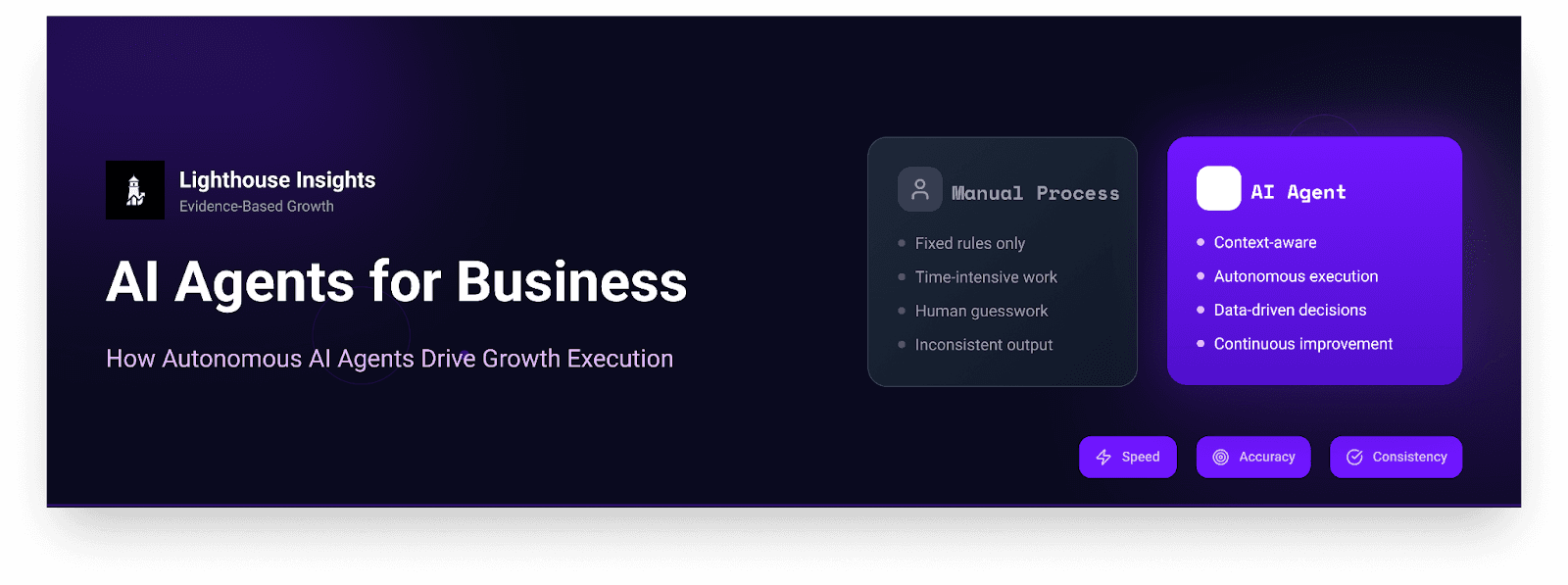
AI agents for business are digital workers that take on specific tasks or decision areas. They analyze information, make recommendations, and perform actions that normally require human judgment. Unlike simple AI automation tools that follow fixed rules, modern AI agents can understand context, adapt to changes, and improve their output as they receive new signals.
For most companies, the purpose of an AI agent is to reduce manual work and give teams support in areas where speed, accuracy, and consistency are important. These agents can help with AI customer insights, market analysis, growth planning, and daily operational decisions. When designed correctly, AI agents for business allow teams to spend less time guessing and more time acting on proven opportunities.
How AI Agents Work and Why They Are Different
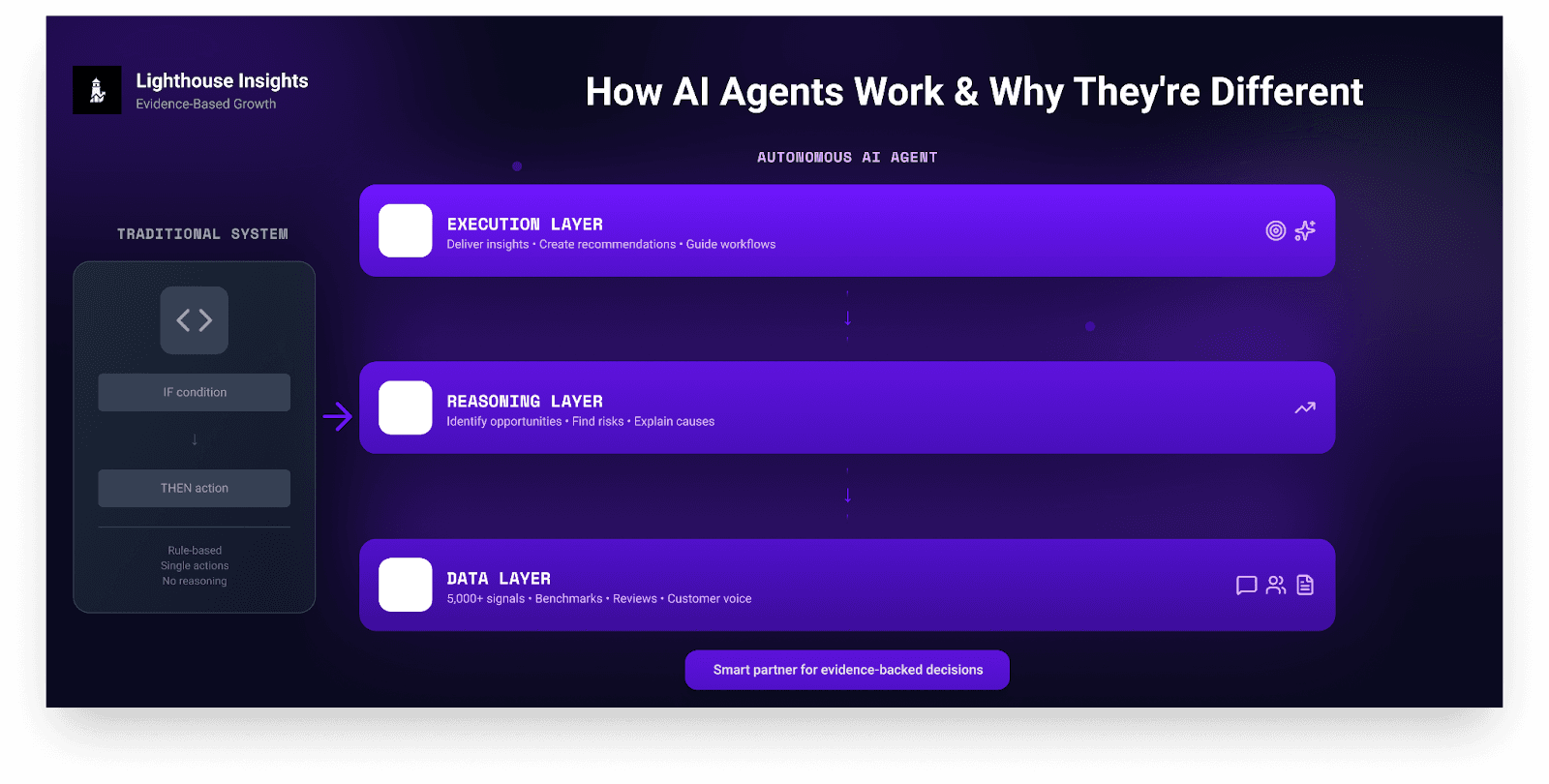
An AI agent is built on a foundation of data and an ability to interpret patterns. Instead of performing one simple action, the agent understands why something is happening and what the best next move may be. This is what makes autonomous AI agents different from traditional scripts or rule-based systems.
A strong AI agent usually includes:
A data layer that processes reviews, benchmarks, performance signals, customer feedback, and internal documents
A reasoning layer that identifies opportunities, risks, and causes behind performance
An execution layer where the agent can deliver insights, create recommendations, surface issues, or guide a workflow
This is where the LighthouseInsights approach stands out. The platform does not build agents from generic internet data. Instead, each agent uses more than 5,000 business signals, competitor gaps, and customer voice patterns. The result is an AI agent that understands what actually moves the needle for your specific market, not a general chatbot that makes surface-level suggestions.
These autonomous agents are not meant to replace teams. They act as smart partners that make everyday decisions clearer and more evidence backed, becoming a practical layer of AI business automation rather than a shiny but disconnected tool.
Practical Use Cases for AI Agents in a Business
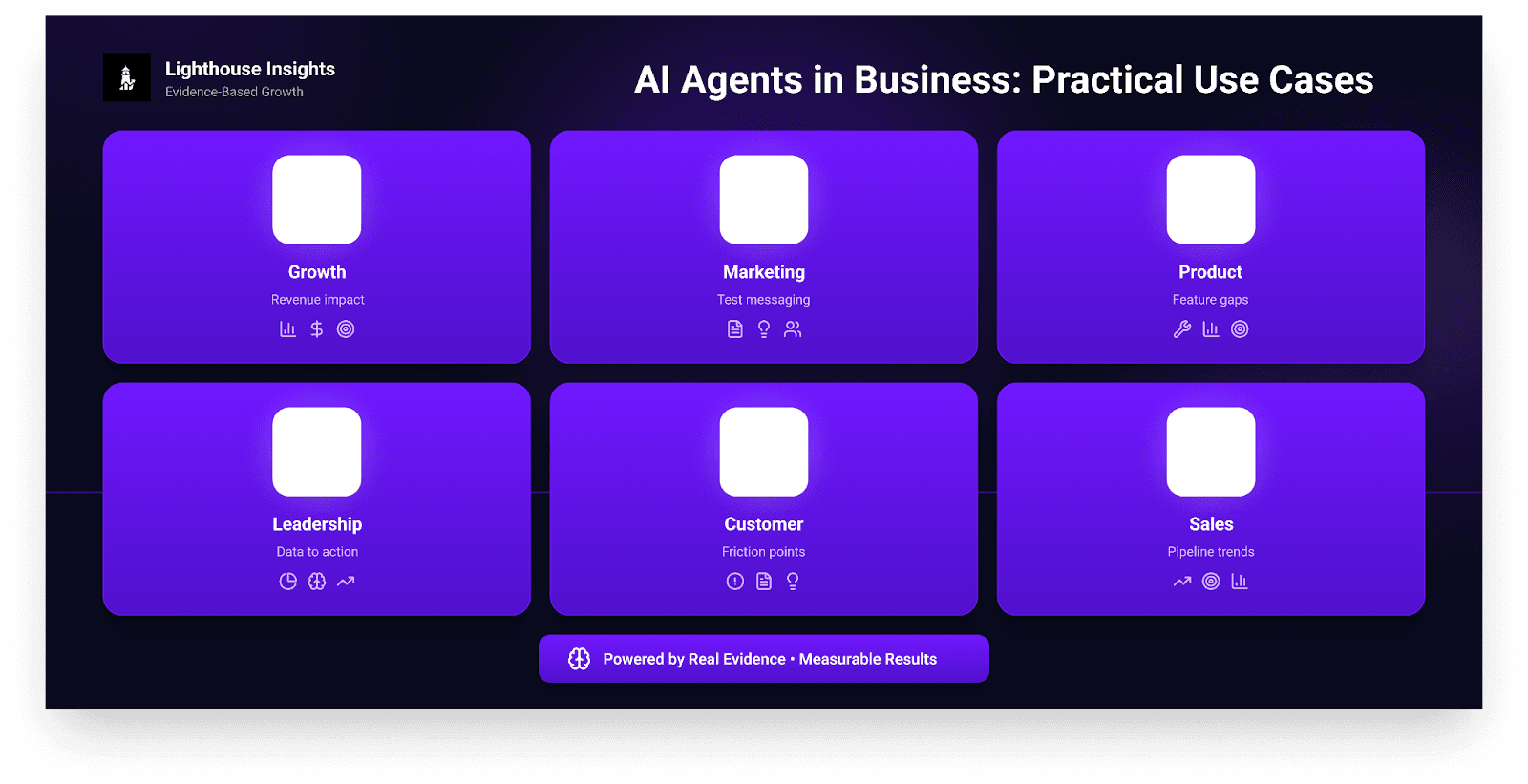
Modern businesses are using AI agents in areas that benefit from fast analysis and accurate recommendations. Here are some common and practical examples:
Growth teams use agents to identify which improvements can produce the highest revenue impact, turning raw data into focused AI growth opportunities.
Marketing teams use agents to test messaging concepts and fix clarity problems on landing pages, working alongside existing AI marketing automation tools.
Product teams ask agents which features matter the most to customers and what gaps competitors are filling.
Leadership teams rely on these autonomous AI agents to turn large amounts of data into simple actions that can be executed without long research cycles.
Customer-facing teams use agents to understand friction points, repeated complaints, and reasons customers do not move forward, powered by deep AI customer insights.
Revenue and sales teams can deploy an AI sales agent to prioritize opportunities, interpret pipeline trends, and surface accounts that are most likely to convert.
With Lighthouse, these agents operate using real evidence. They highlight problems that block growth, explain patterns in customer behavior, and guide teams towards the improvements that create measurable results.
Why AI Agents Are Becoming a Core Part of Business Growth
Most companies have more data than they can process. Teams spend time debating ideas, running small experiments, or doing manual analysis to understand what to prioritize. This slows down growth and leads to inconsistent execution.
AI agents for business solve this by giving companies a consistent and always-available source of clarity. They can evaluate performance across competitors, market signals, customer expectations, and internal operations. They turn thousands of data points into clean explanations such as what is broken, why it matters, and what to fix next.
For Lighthouse users, the benefit is direct. Action agents behave as digital analysts that look at everything your market is doing and tell you what you should do right now. They bring together competitive benchmarks, customer voice insights, and growth frameworks into a single system that supports every team, from marketing to product to strategy, acting as a practical layer of AI business automation that keeps execution aligned with real-world signals.
Bringing It All Together
AI agents for business are not just technical tools. They are practical partners that remove uncertainty, accelerate decision making, and help teams execute with confidence. They reduce manual work, surface growth opportunities, and guide improvements supported by real evidence.
LighthouseInsights builds action agents with one purpose: help companies focus on the right actions, understand what truly impacts revenue, and give every team the clarity they need to perform at their highest level. By combining AI automation, autonomous AI agents, and targeted AI customer insights, Lighthouse turns AI agents into a reliable engine for continuous, evidence-backed growth.
Related blog
Reading more blogs can be a powerful way to expand your knowledge, stay updated on industry trends, and gain fresh perspectives.