28 December, 2025
AI business strategy in practice: How AI agents improve decision quality at speed
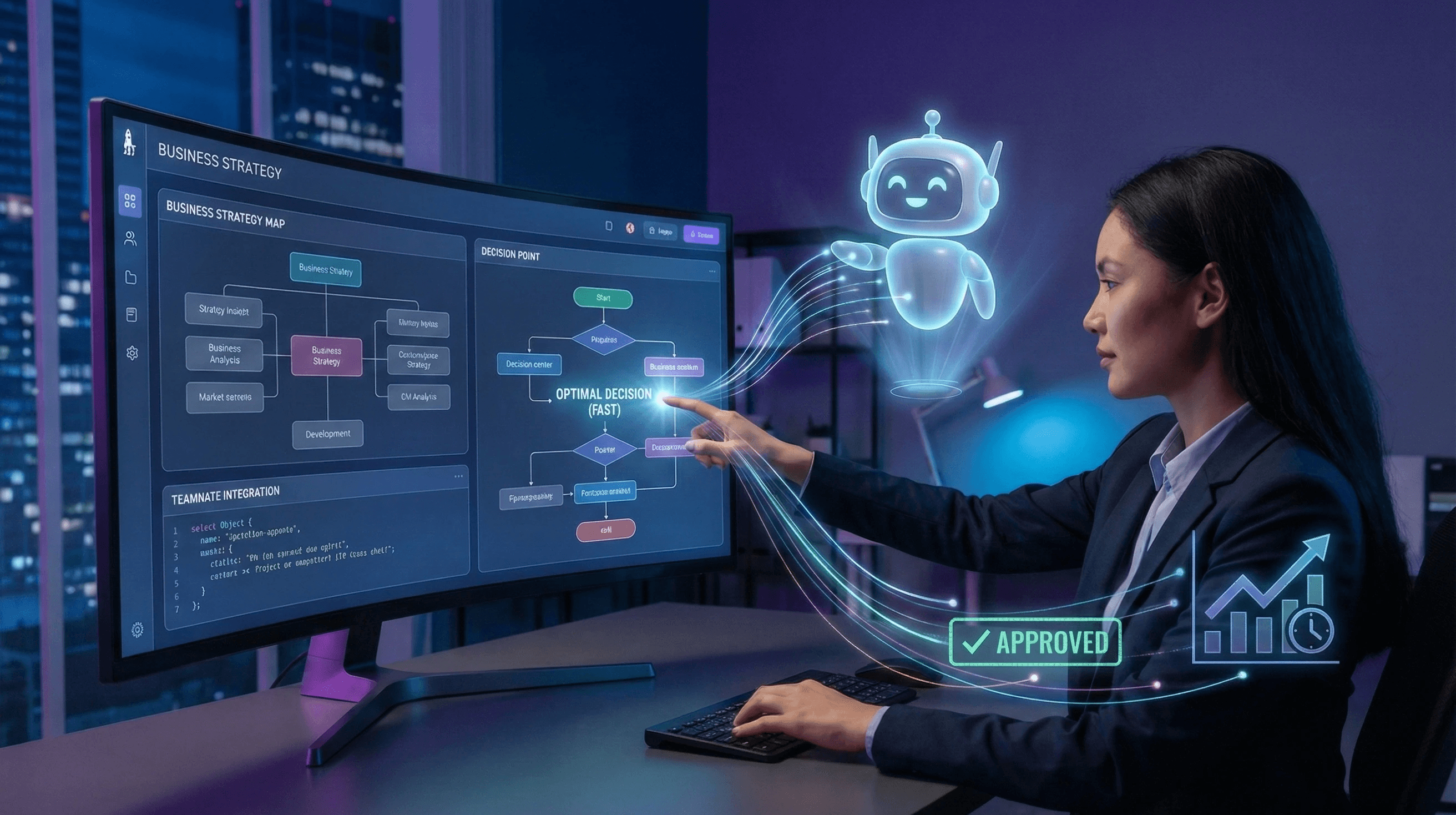
AI is now embedded across most business stacks, but strategy only improves when decisions improve. Reports and dashboards summarize what happened. Copilots assist individuals in interpreting information. AI agents go a step further. They operate at the system level, continuously interpreting signals, evaluating options, and supporting decisions in motion. This shift is reshaping how modern AI business strategy actually works.
Why Traditional Strategy Execution Slows Down Decisions
Most organizations struggle not with data access, but with decision latency. Signals arrive from markets, customers, operations, and competitors at different speeds and levels of confidence. Strategy teams analyze. Operators wait. By the time direction is clear, conditions have already changed.
This gap is structural. Strategy is often separated from execution by layers of tooling and handoffs. Even when insights are strong, they arrive too late or lack context for action. An effective AI business strategy must close this gap by embedding decision support directly into operational workflows.
What AI Agents Change Compared to Tools and Dashboards
AI agents are not passive systems. They are designed to observe, interpret, and respond continuously. Instead of answering a single query, an agent maintains context over time. It tracks objectives, constraints, and evolving signals, then adjusts recommendations as conditions change.
This makes the agent behave like an AI expert focused on a specific domain or decision space. Rather than presenting raw insights, it reasons about implications. It can flag emerging risks, suggest trade-offs, or highlight second-order effects that are easy to miss under pressure. The result is not faster answers, but better decisions made earlier.
Decision Quality Improves When Interpretation and Action Stay Connected
Speed alone is rarely the bottleneck. Consistency and alignment are. When interpretation is separated from execution, teams apply insights unevenly. AI agents reduce this problem by staying involved from signal detection through action validation.
Because agents operate continuously, they help organizations learn faster. Decisions become experiments with feedback built in. When assumptions fail, the system adapts. Over time, this compounds into stronger strategic judgment across teams, not just isolated wins.
How Lighthouse Uses AI Agents to Support Real Strategy
LighthouseInsights.io is built around this principle. The platform focuses on interpretation first, turning fragmented signals into coherent reasoning that teams can act on. Rather than functioning as a reporting layer, Lighthouse positions AI agents as active participants in decision-making.
Within this framework, action agents help translate interpreted insights into concrete next steps. They support prioritization, coordination, and execution without stripping away human ownership. Strategy remains a human responsibility, but it is reinforced by systems that understand context and consequence.
In practice, this approach allows AI business strategy to operate at the speed of change. Decisions are informed by live signals, guided by structured reasoning, and validated through action. That is how AI agents move strategy from planning to performance.
Related blog
Reading more blogs can be a powerful way to expand your knowledge, stay updated on industry trends, and gain fresh perspectives.