28 December, 2025
AI powered insights vs traditional dashboards: Why charts no longer drive revenue
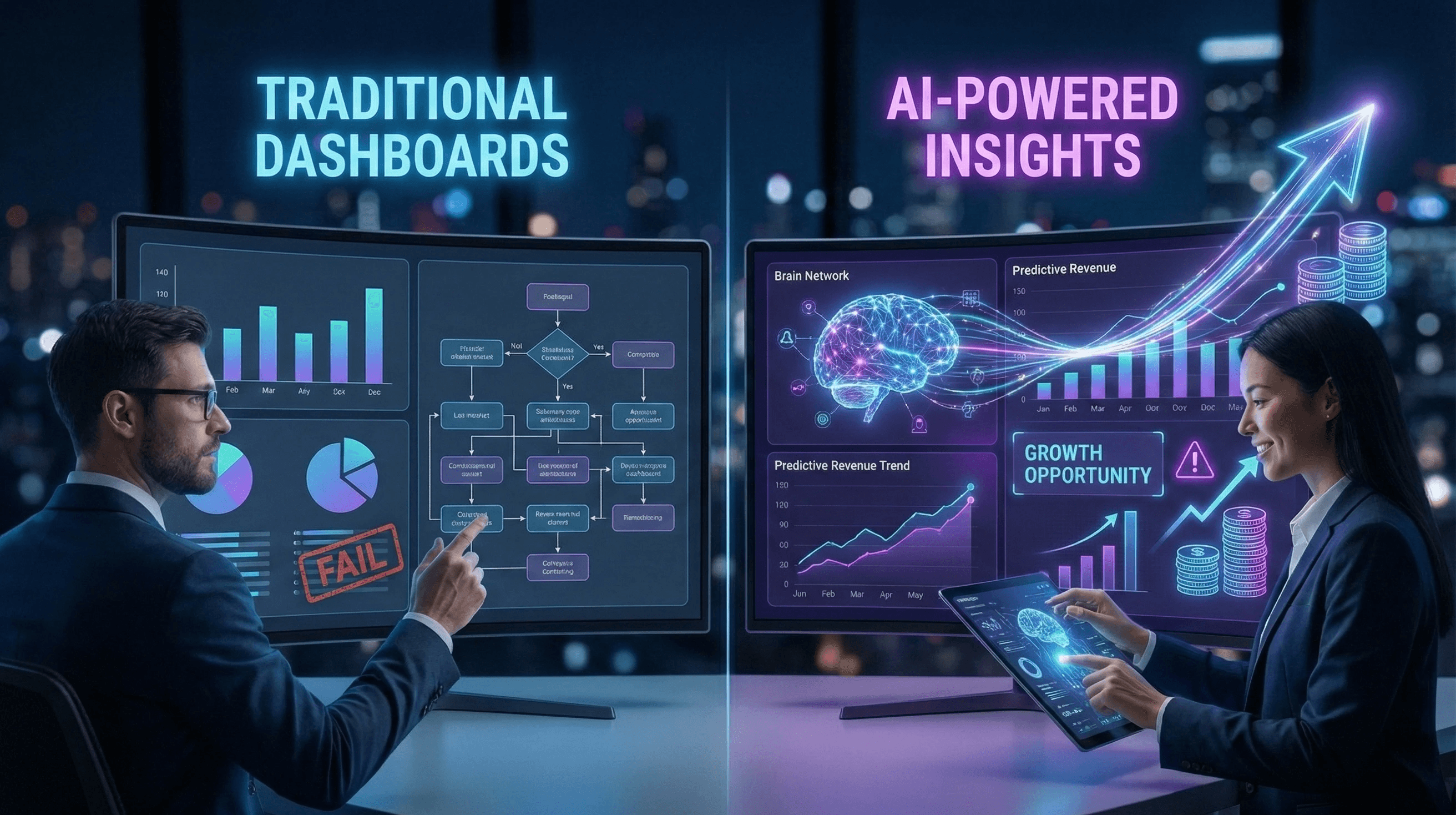
Most teams already have dashboards. They track traffic, conversion rates, CAC, retention, and dozens of other metrics. Yet revenue growth often stalls despite having more data than ever.
The issue is not a lack of visibility. It is a lack of interpretation and action. Traditional dashboards describe what happened. They rarely explain why it happened or what to do next. This gap is where ai-powered insights start to matter.
Why Traditional Dashboards Stop Short
Dashboards are designed to summarize historical data. They aggregate metrics into charts and tables that still require human interpretation. A spike, a dip, or a flat line quickly turns into another meeting rather than a decision.
Teams are left asking familiar questions. What caused this change? Which segment drove it? Is this a real signal or short-term noise?
Answering these questions often means exporting data, building custom reports, or relying on intuition. Decision cycles slow down, ownership becomes unclear, and insights arrive too late to influence outcomes.
Dashboards also treat all metrics as equal. Subtle but commercially important shifts in customer behavior can be hidden beneath surface-level performance indicators. Revenue impact becomes indirect and hard to trace.
What AI-Powered Insights Do Differently
Ai-powered insights shift the focus from visualization to interpretation. Instead of showing more charts, they analyze patterns across datasets and surface what matters most for growth.
At a high level, modern AI models detect relationships, anomalies, and emerging trends across customer behavior, product signals, and market dynamics. They connect data points that are difficult to link manually, especially at scale.
The output is not another dashboard. It is a clear insight tied to a business question. For example, identifying which customer segments are showing early purchase intent, or which product signals indicate rising churn risk before it appears in revenue data.
This is the core difference between reporting data and reasoning with data.
Turning Insights Into a Growth Engine
Insights only create value when they lead to action. This is where Lighthouse moves beyond analytics tools.
The Lighthouse platform is built as a growth engine, not a reporting layer. It continuously analyzes internal and external signals, interprets them, and translates them into prioritized opportunities for teams.
Instead of asking teams to hunt for insights, Lighthouse surfaces where growth is being created or lost. It highlights which decisions matter now, which experiments are worth running, and which assumptions no longer hold.
This changes how teams collaborate. Strategy discussions become evidence-led. Product, marketing, and growth teams operate from a shared understanding of what is driving outcomes, rather than debating metrics in isolation.
Why Revenue Growth Requires Interpretation, Not More Charts
Revenue growth depends on timing and focus. Knowing what happened last quarter is useful, but knowing what is changing right now is more powerful.
Traditional dashboards are backward-looking by design. Ai-driven insights are forward-looking. They help teams anticipate shifts in demand, customer behavior, and competitive pressure before they show up in lagging metrics.
This is why companies adopting ai-powered insights move faster. They spot opportunities earlier, reduce guesswork, and align execution around the signals that matter most.
Charts show performance. Interpretation drives growth. Lighthouse is built for the second part.
Related blog
Reading more blogs can be a powerful way to expand your knowledge, stay updated on industry trends, and gain fresh perspectives.