28 December, 2025
Business strategy - AI in practice: How AI business coaches improve planning quality
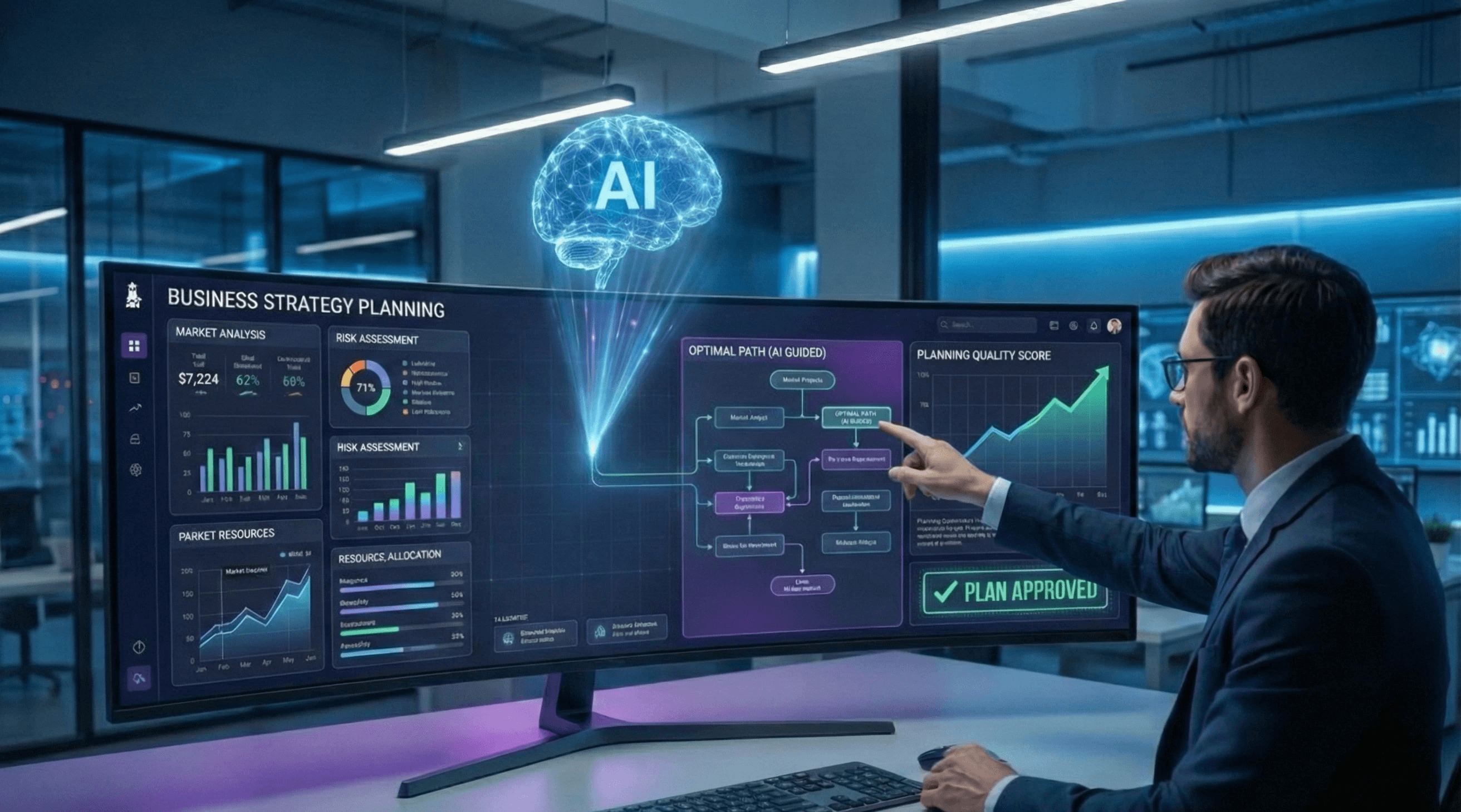
Business strategy has always struggled with one core problem. Decisions are made with incomplete information, delayed feedback, and internal bias. Strategy decks look polished, but execution often reveals gaps that were invisible during planning. Business Strategy AI is emerging to address this gap, not by automating decisions, but by improving how decisions are formed.
At the center of this shift is a new category of tools often described as AI business coaches. These systems do not replace leadership judgment. Instead, they help teams test assumptions, interpret signals, and pressure-check plans before they are shipped.
Why Traditional Strategy Breaks Down at Speed
Most strategy processes were designed for slower markets. Quarterly reviews, annual plans, and static KPIs worked when change was incremental. Today, customer behavior, competitor moves, and operational constraints shift continuously.
The failure is not a lack of data. It is the inability to synthesize signals fast enough. Dashboards report what already happened. Meetings rehash opinions. By the time a plan is approved, the underlying conditions may have changed.
Business Strategy AI focuses on closing this gap. Rather than presenting raw metrics, it evaluates patterns, contradictions, and second-order effects. It highlights where a plan conflicts with market signals or internal constraints before those conflicts become costly.
What AI Business Coaches Actually Do
An AI business coach operates as a reasoning layer on top of existing business data. It ingests inputs such as performance metrics, customer feedback, market signals, and strategic goals. Instead of outputting charts, it generates structured perspectives.
For example, it may flag that growth assumptions rely on a segment showing declining intent. Or it may surface that operational capacity is misaligned with projected demand. The value lies in interpretation, not prediction.
This is why Business Strategy AI works best when positioned as a coaching system. It challenges plans, asks better questions, and forces clarity. Teams move faster because fewer cycles are wasted validating flawed assumptions after execution has already begun.
From Insight to Action Without Over-Automation
One common misconception is that AI strategy tools aim to automate planning. In practice, the opposite is true. The strongest systems reduce automation in decision-making while increasing rigor.
AI business coaches do not issue commands. They present trade-offs, risks, and scenarios in a way that is immediately usable by leadership teams. This preserves accountability while raising decision quality.
As a result, strategy becomes less about defending opinions and more about responding to evidence. Plans ship faster not because they are rushed, but because fewer revisions are required later.
Turning Strategic Signals Into Executable Decisions
For Business Strategy AI to work in practice, insights must translate into action without friction. This requires a system that can continuously connect data, context, and intent into a single decision layer.
That is where platforms like LighthouseInsights.io come into play. Rather than acting as a passive analytics tool, Lighthouse is designed to interpret signals across the business and challenge strategic assumptions in real time. Within this environment, the AI business coach acts as a strategic counterpart to leadership teams, evaluating plans against market evidence and internal constraints.
The outcome is not more analysis, but stronger plans that survive contact with reality. Business Strategy AI becomes valuable when it improves decision quality at speed, and AI business coaches are increasingly becoming the layer that makes this possible.
Related blog
Reading more blogs can be a powerful way to expand your knowledge, stay updated on industry trends, and gain fresh perspectives.