17 December, 2025
Customer personas explained: Why traditional models fail and how AI changes the picture
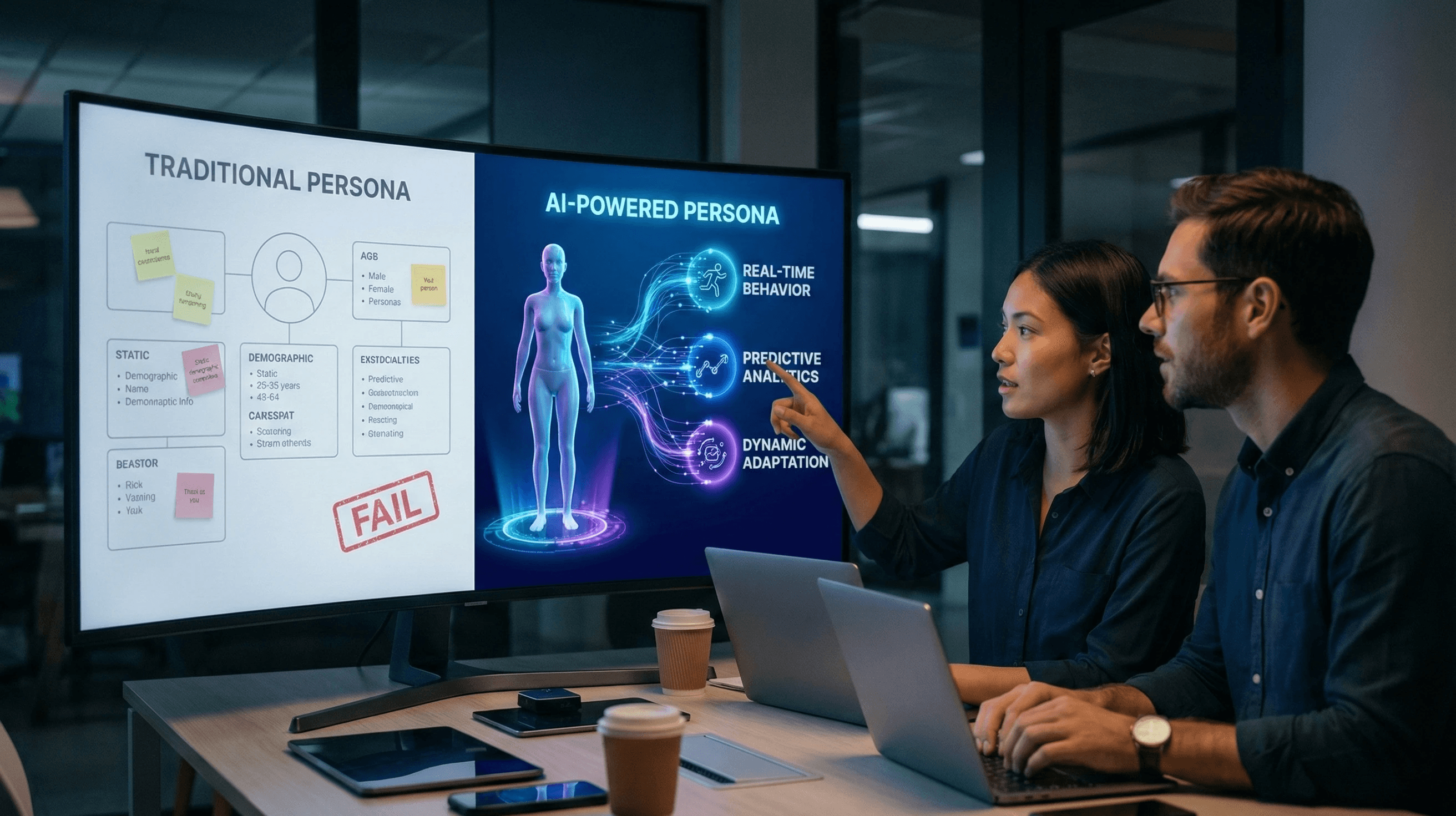
Customer personas have been a core part of marketing and product strategy for years. They are meant to clarify who you are building for, how buyers think, and why they choose one solution over another. Yet in practice, many teams quietly stop using them. The documents exist, but decisions move on without them.
The reason is not that customer personas are a bad idea. It is that most traditional approaches cannot keep up with how real buyers behave today.
Why Traditional Customer Personas Break Down
Classic customer personas are usually built from interviews, surveys, and workshops. They reflect a snapshot in time. Once documented, they rarely change.
Markets do not work that way anymore. Buyer behavior shifts with pricing changes, competitors, economic pressure, and new channels. Static personas struggle to represent this reality. They often rely on assumptions rather than signals, and they simplify complex decision processes into a single narrative.
Another issue is scale. A handful of interviews cannot represent thousands of customers with different motivations, objections, and buying paths. As a result, teams argue about whether a persona is accurate instead of using it to guide decisions.
Over time, customer personas become artifacts rather than tools. They are referenced in decks, but not trusted when it matters.
What AI Brings to Customer Personas
AI does not replace the idea of customer personas. It changes how they are built and maintained.
Modern AI systems can analyze large volumes of real data, such as CRM records, product usage, support tickets, reviews, and behavioral signals. Instead of guessing what customers care about, AI looks for patterns in what they actually do and say.
This allows AI customer personas to reflect reality more closely. Motivations, objections, and priorities are derived from observed behavior rather than opinion. When inputs change, the personas can update as well.
Importantly, this does not require deep technical complexity. At a high level, AI groups customers based on similarities in behavior and language, then summarizes those patterns in a way humans can understand and use.
The result is a more grounded view of the customer that evolves with the business.
The Role of a Customer Persona Generator
A customer persona generator built on AI acts as a bridge between raw data and strategic insight. Instead of starting from a blank template, teams start from evidence.
These systems synthesize multiple data sources into structured personas that describe goals, decision drivers, risks, and buying signals. Because the process is automated, it becomes easier to refresh personas regularly rather than treating them as one-off projects.
This also reduces internal bias. Marketing, sales, and product teams often have different views of the customer. A customer persona generator provides a shared reference point based on data, not hierarchy or opinion.
The value is not speed alone. It is consistency. Everyone works from the same underlying signals, which improves alignment across teams.
How AI Personas Support Better Business Decisions
When customer personas are grounded in live data, they become practical tools again. Teams can test messaging against real objections, prioritize features based on actual usage patterns, and spot shifts in buyer behavior earlier.
AI-driven personas also support scenario thinking. You can see how different segments respond under different conditions, rather than assuming one persona fits all contexts.
This changes how decisions are made. Instead of asking whether a persona feels right, teams ask whether the signals support a specific action. That shift leads to clearer prioritization and fewer subjective debates.
Customer personas work best when they reflect reality. AI makes that possible by connecting strategy directly to customer behavior, not assumptions.
Related blog
Reading more blogs can be a powerful way to expand your knowledge, stay updated on industry trends, and gain fresh perspectives.