8 December, 2025
Find out more about our AI Buyer Personas

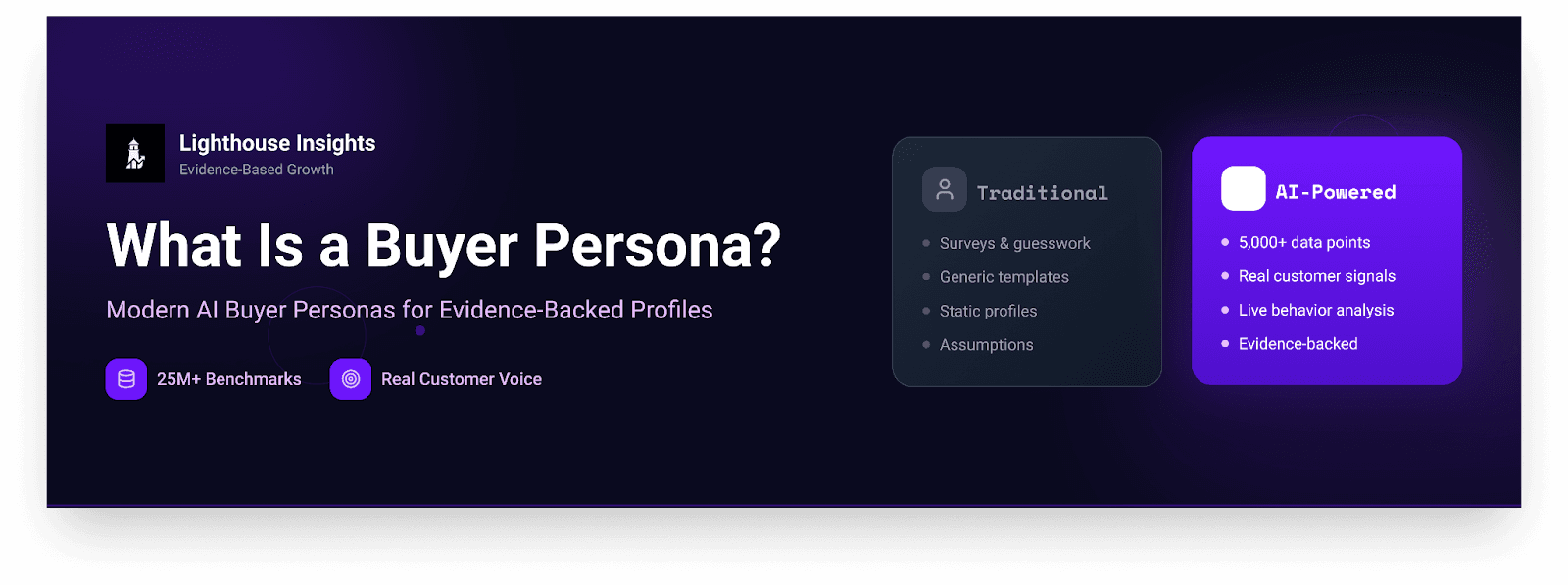
If you’ve ever wondered what is a buyer persona, the simplest answer is this: a buyer persona is a simplified profile of your ideal customer, how they think, buy, compare options, and respond to customer feedback across channels.
Traditionally, companies build a buyer persona or customer persona through surveys, guesswork, and a few interviews. The problem is that these personas often stay generic, outdated, or overly flattering. They do not show what customers really think, and they rarely capture patterns across search, reviews, support interactions, or conversational AI customer experience tools. Even when teams use a polished buyer persona template or collect buyer persona examples, the result often remains static and disconnected from real behavior.
This is where modern AI buyer personas solve a major gap. Instead of assumptions, they rely on real customer signals such as reviews, competitor feedback, support tickets, search behavior, and market benchmarks. At Lighthouse Insights, these signals come from more than 5,000 data points per business and over 25 million benchmark records. The result is not a fictional avatar but a customer voice model powered by AI that reflects what buyers praise, complain about, and leave you for. It also introduces an interactive AI voice of customer layer that teams can use to ask questions and gather insights instantly.
Why Buyer Personas Matter Today
Modern teams in product, growth, and AI assisted marketing need more than a vague description of an ideal shopper. They need an ideal customer profile and buyer persona that can explain why people convert, why they hesitate, and how they choose between you and competing products.
A traditional B2C buyer persona might describe a broad group such as parents who shop online or fitness enthusiasts in their twenties. But it rarely shows the real decision path across search, social, reviews, mobile browsing, conversational interactions, and checkout flows. It does not explain why a customer abandoned their cart yesterday or what concerns they had when comparing you with a rival brand.
An AI buyer persona solves this gap by connecting qualitative signals such as repeated phrases, emotional triggers, and objections with quantitative patterns such as cart abandonment and repeat purchase behavior. It becomes a living model of your customer that updates with real behavior and incorporates voice of customer AI patterns at scale. Instead of a static description in a brand guide, teams get an evidence backed explanation of what motivates buyers and what stops them from moving forward.
How AI Buyer Personas Are Built Using Real Customer Signals
Most AI personas on the market simply remix generic demographic templates. They might feel like a fancy AI persona generator, but under the hood they still rely on static assumptions. Evidence backed AI buyer personas go deeper because they analyze real customer language to explain behavior and surface friction.
For example, Lighthouse AI builds personas by scanning:
Your reviews and competitor reviews
Conversion friction signals
Support transcripts and customer feedback
Market benchmark gaps
Feature level demand patterns
Sentiment shifts across each customer segment
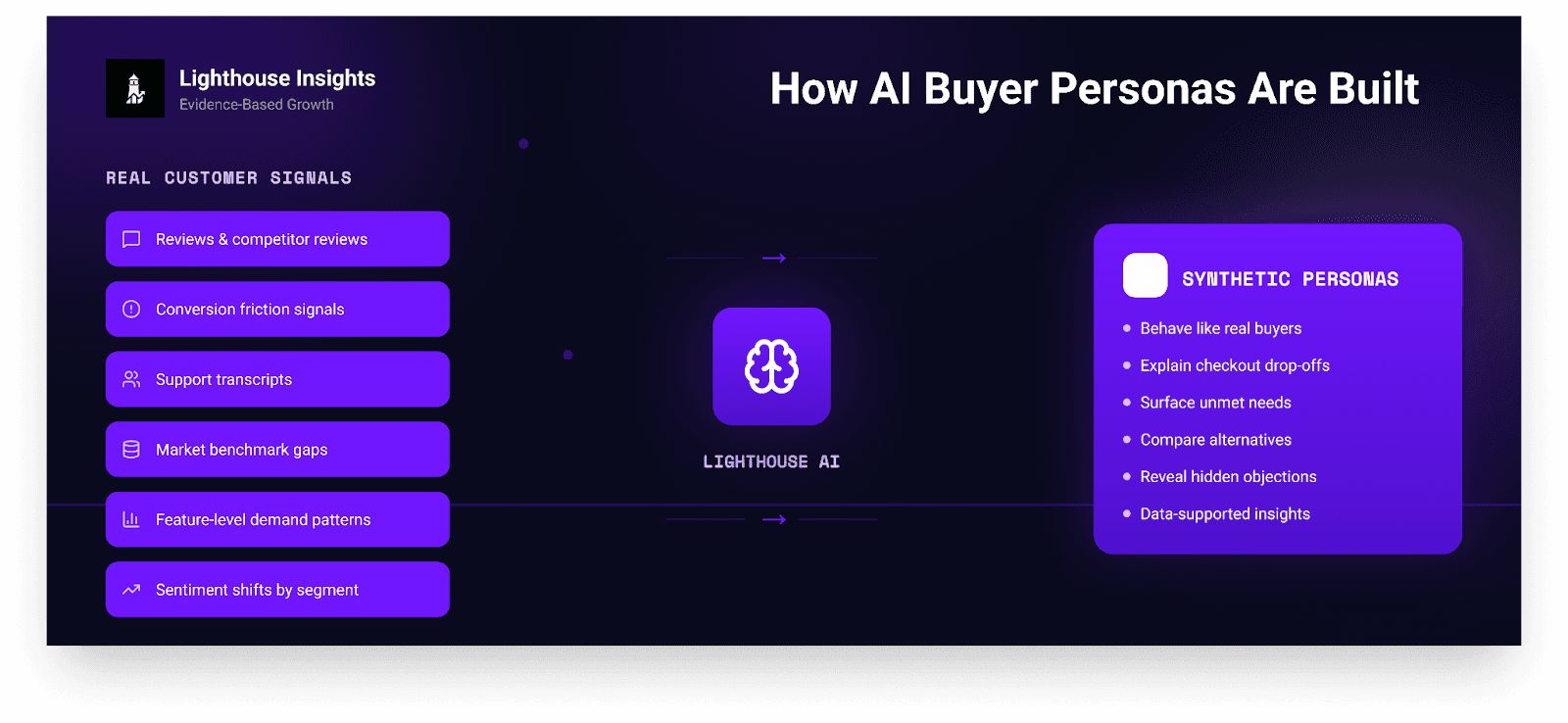
Once processed, the system generates synthetic customer profiles that behave like real buyers. In practice, they act as AI powered buyer persona examples grounded in your own data, not generic stereotypes.
Because Lighthouse personas function as customer AI agents, teams can chat with them directly to understand objections, test messaging, or diagnose friction. This introduces a new layer of conversational AI customer experience where the persona can highlight unmet needs, explain why they might skip checkout, or compare alternatives like an actual buyer would.
Why AI Buyer Personas Are More Accurate Than Traditional Personas
Modern teams need personas that evolve as the market changes. Static PDFs, slides, and one time buyer persona development workshops cannot keep up with real customer behavior, especially as user expectations shift or competitors launch new features.
AI personas stay dynamic because they refresh automatically as new data appears. They reveal:
The exact moments customers would churn
What messaging increases confidence
Which features matter most by segment
Competitor strengths that influence buying decisions
Pricing sensitivities and emotional drivers
Unlike a one time buyer persona definition created during a strategy offsite, AI driven personas incorporate new signals continuously through AI customer insights and voice of customer data. For complex buying scenarios, this provides a more accurate picture than a traditional research process ever could.
This evidence backed approach reduces guesswork in product development, marketing, UX, and customer success. Teams avoid building unused features, stop writing vague copy, and can validate decisions in product, pricing, and positioning using real customer sentiment instead of outdated assumptions.
How Businesses Use AI Buyer Personas to Drive Faster Growth
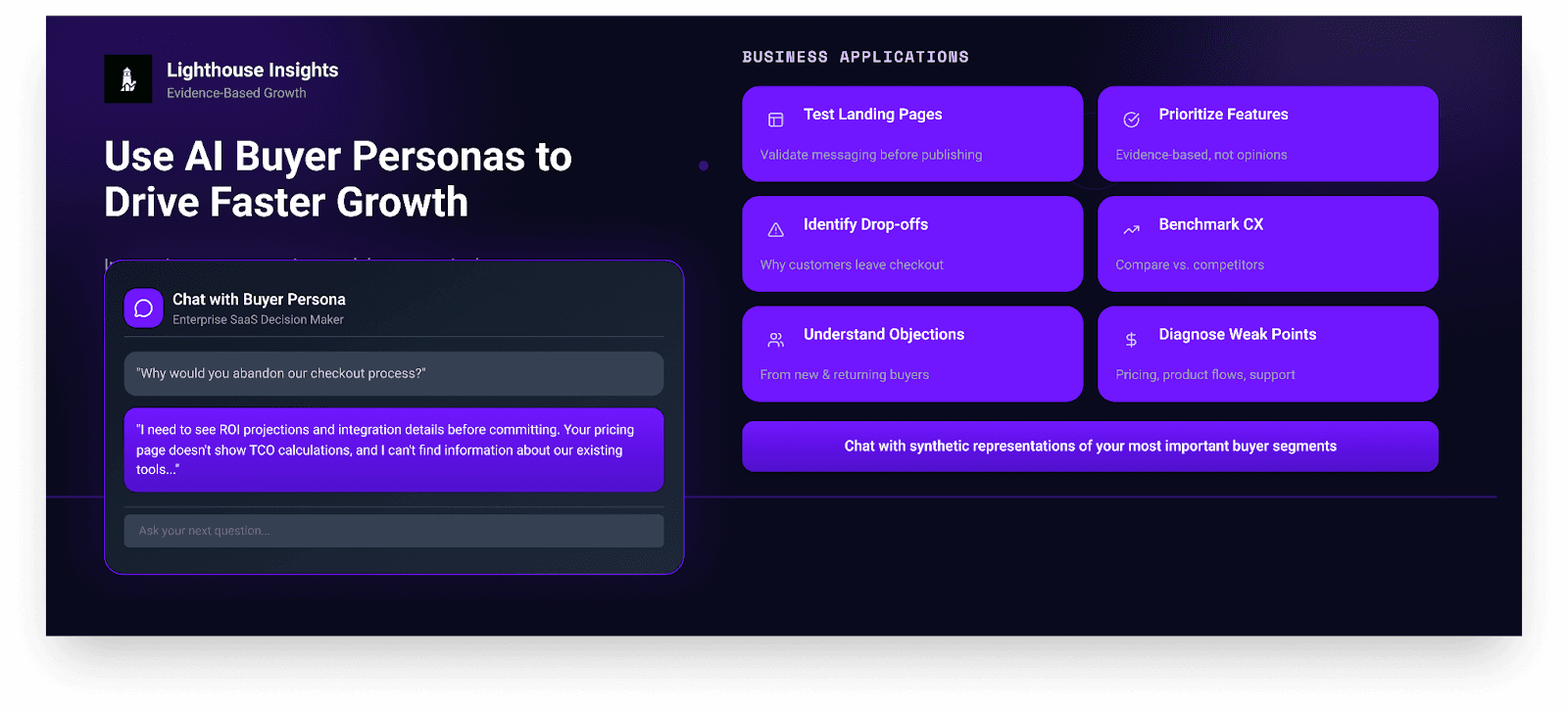
AI buyer personas become most powerful when teams use them as interactive customer voice models rather than static documents. Instead of reading a PDF, teams can chat directly with AI agents trained to behave like specific buyer segments.
Businesses use Lighthouse personas to:
Test landing page messaging before publishing
Prioritize features with evidence, not opinions
Identify why customers leave onboarding or checkout
Benchmark customer experience against competitors
Understand objections from first time and returning buyers
Diagnose weak pricing pages, product flows, and support
Because these personas are trained on real signals, they do not sugarcoat anything. They reveal friction that slows revenue and pinpoint opportunities where small improvements unlock measurable gains. For teams investing in AI in marketing, AI buyer personas and customer AI agents provide the most direct path to continuous optimization without needing to rebuild personas from scratch every quarter.
Related blog
Reading more blogs can be a powerful way to expand your knowledge, stay updated on industry trends, and gain fresh perspectives.